
Don't Uproot What’s Been Planted
Israel, June 2024

“We’ve always described Kfar Aza as ninety-five percent heaven and five percent hell,” says Liora Eilon. “On October 7, it was the other way around.” For many members of the kibbutz, a constant yearning for peace with their neighbors in the Gaza Strip has been a strong component of life in the heaven on arid earth they have built against all odds, for over seventy years.
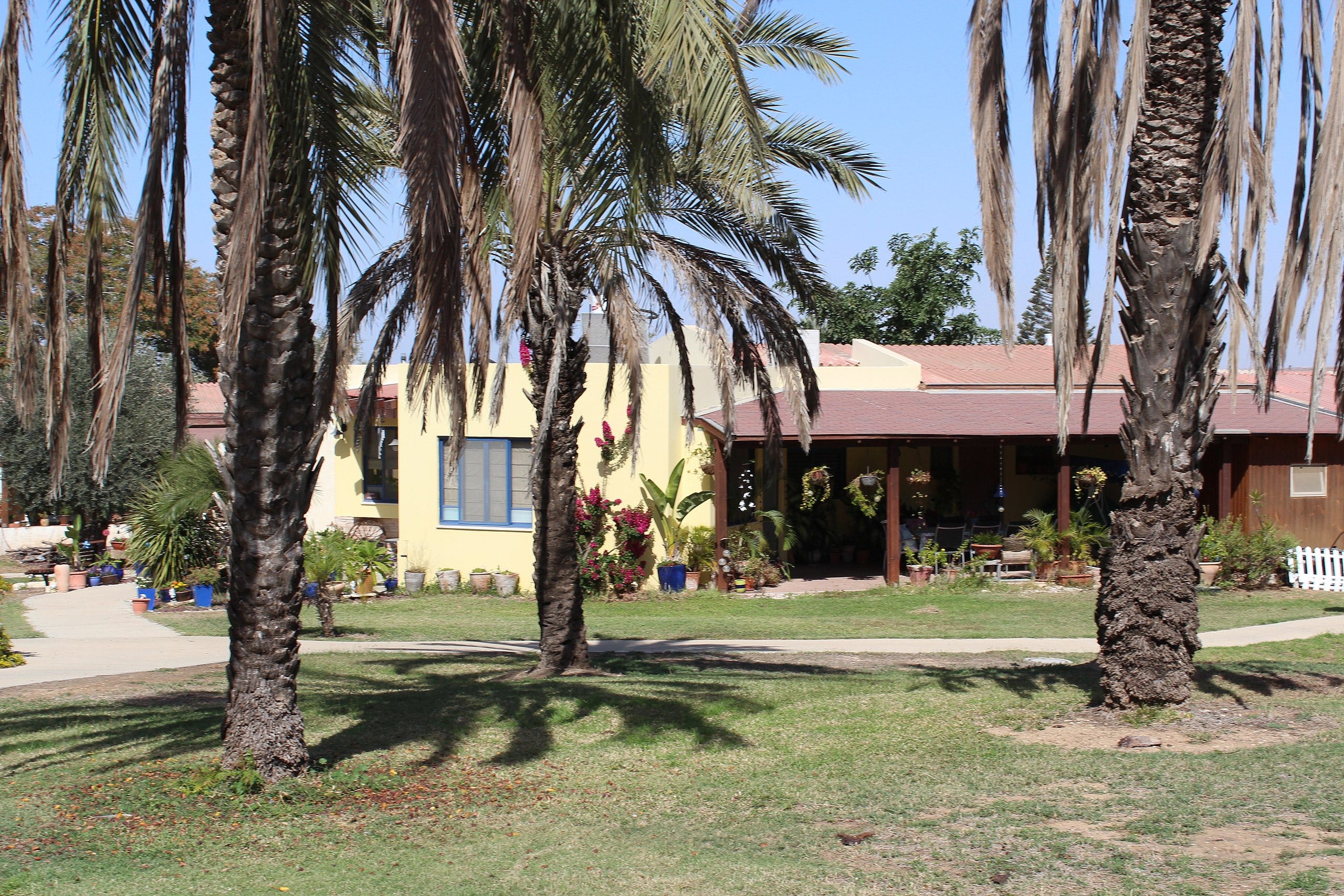
On October 6, 2023, the residents of Kfar Aza were busy preparing for their annual kite festival, putting together kites with materials provided by the festival’s organizer, Aviv Kutz, and planning to fly them over Gaza the next day, adorned with messages of peace.
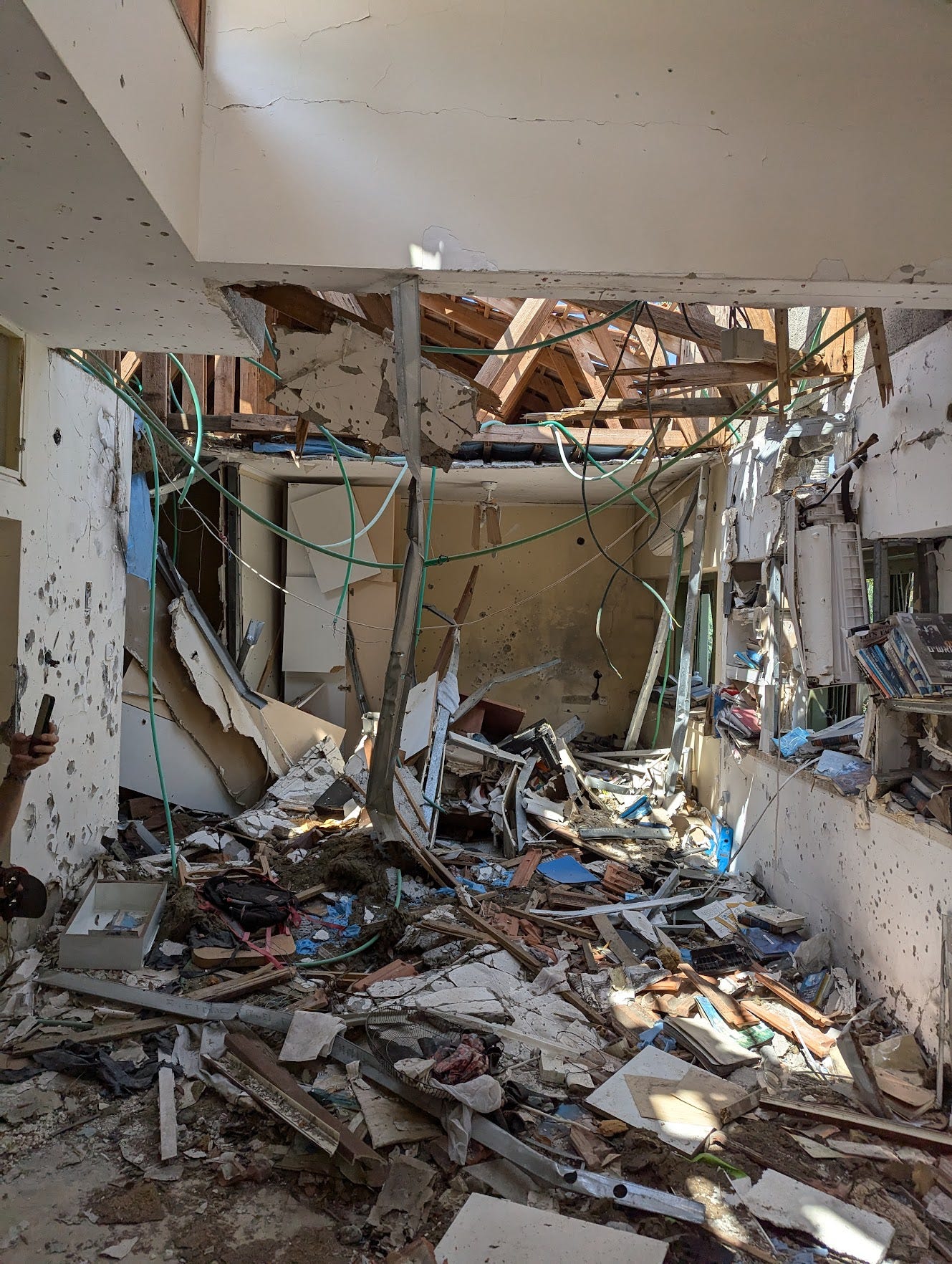
What flew the next day over the fence surrounding Kfar Aza, however, were Hamas terrorists determined to destroy the heaven on earth, the kind of heaven that they haven’t developed in the Gaza Strip after it was handed to them by the Israeli government in 2005. What the members of Kfar Aza have managed to do with sheer determination and lots of hard work was so troubling to the terrorists, such a constant upsetting reminder of what they could never achieve, that first and foremost they had to remove from the heaven on earth, preferably in the most horrific way possible, the people who created it.
All five members of the Kutz family — Aviv (53), his wife Livnat (49), and their children, Rotem (19), Yonatan (17), and Yiftach (15), were massacred, along with 60 other Kfar Aza residents. 19 were taken hostage, including 3-year-old Avigayil Idan.
Her father Roee Idan, a Ynet photographer, managed to take photos of the terrorists paragliding into the kibbutz and send them to his editors. The next thing he did, says Liora Eilon, “was to call my son, Tal, who was the commander of the civil defense team, the first response team, to tell him what he's seeing.” At that moment, his 3-year-old daughter Avigayil ran out of their house towards him. When he grabbed her, he was shot and fell to the ground. Covered with her father’s blood, Avigayil crawled from under him and ran to the house of the Brodutch family.
The terrorists killed her mother Smadar, while her siblings, Michael (9) and Amalya (6), hid for the next 14 hours in a closet in their house. Liora recounts how Michael called his grandmother and told her “Abba (father) is dead.” She reprimanded him for making a bad joke, so he sent her a photo of his father’s body. When she asked to speak to his mother, he showed her the body of his mother lying on the floor next to him.
Michael and Amalya were eventually rescued. Avigayil was taken to Gaza together with Hagar (40), Ofri (10), Yuval (9) and Oriya Brodutch (4). The bodies of her parents, Roee (43) and Smadar (38), were identified only on October 18.
70-year-old Liora Eilon has lived for many years in Kfar Aza, raising four children. On June 24, 2024, she took a group of journalists, myself included, on a tour of the Kfar Aza devastation, sharing with us the harrowing details of the massacre. From the early morning hours of October 7, she has spent thirty-five hours with her son, daughter, and two granddaughters in her home’s small safe room. The terrorists tried to enter it but her son and daughter managed to block them by taking turns holding the handle of the door (a safe room cannot be locked from inside). Liora’s other son, Tal, was killed fighting the terrorists, as were six other members of the 14-strong local security team.
Liora Eilon says she has always been a peace activist and will continue to be a peace activist. Asked how does she see the Israeli-Palestinian conflict get resolved, she answered: “Changing governments on both sides. Education, many years of education that will make people realize that we tried war and it didn't work for us, so it's now time to try something else.”
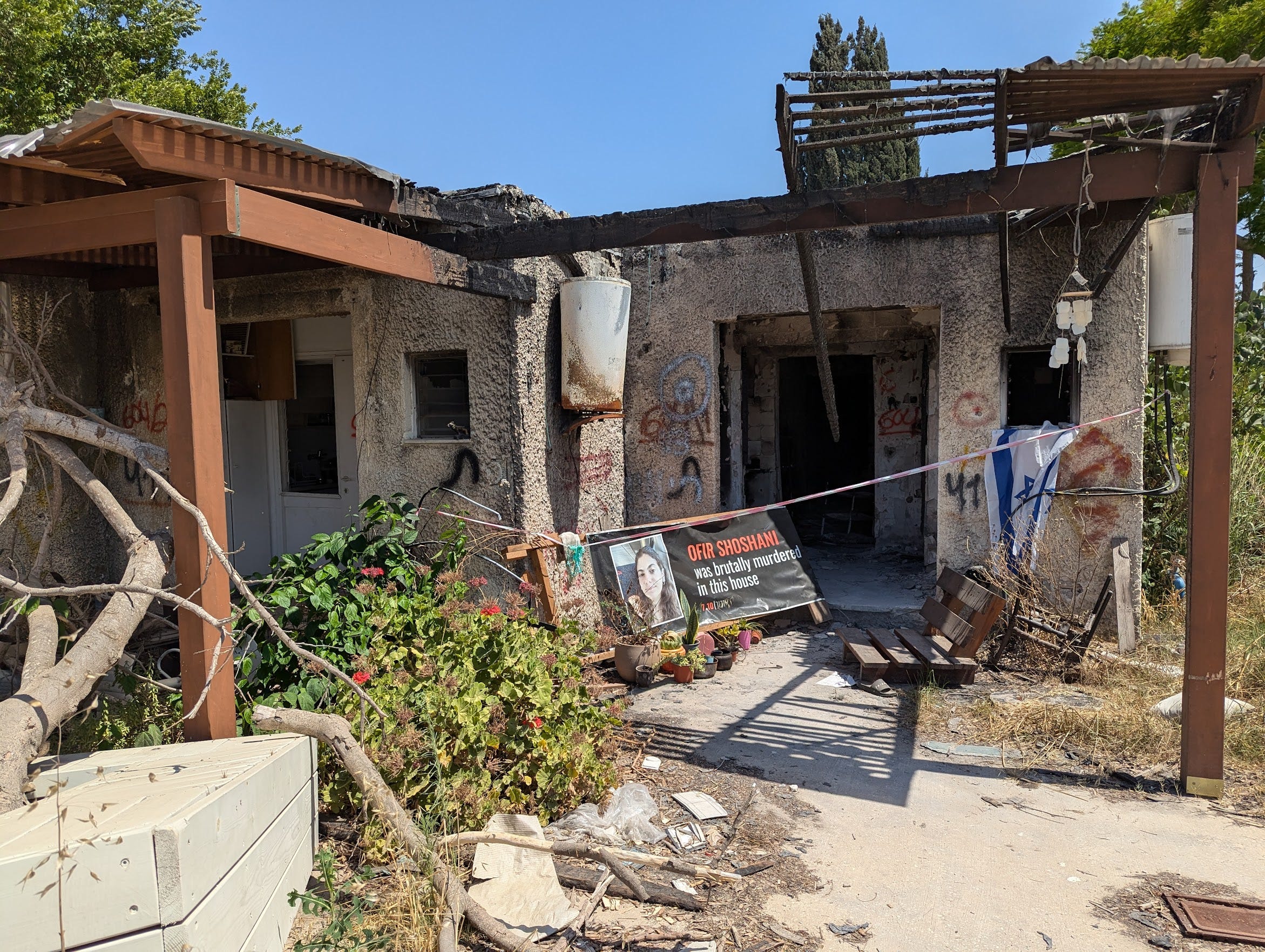
From Kfar Aza, we drove to kibbutz Re’im, the site of the Nova music festival where 364 people were murdered and 44 were abducted. In addition, 17 policemen were killed fighting the terrorists. Later, we visited the field shelter where 30 festival attendees tried to hide from the terrorists. 26 were murdered or taken hostage. We also saw the compound housing 1,560 vehicles collected from the region’s roads that were burned and destroyed together with their occupants.
On the way back to Tel-Aviv, where our group met over the next few days with many Israeli startups that continue to innovate and succeed despite the war, I thought about another hate- and resentment-driven attack on Jewish life and property, the 1929 Arab riots. The week before the trip to the Gaza border communities, I visited the Haifa Historical Society, where I looked at contemporary newspaper reports describing the 1929 destruction of the farm in Haifa Bay established by Efraim Catz, my maternal grandfather.
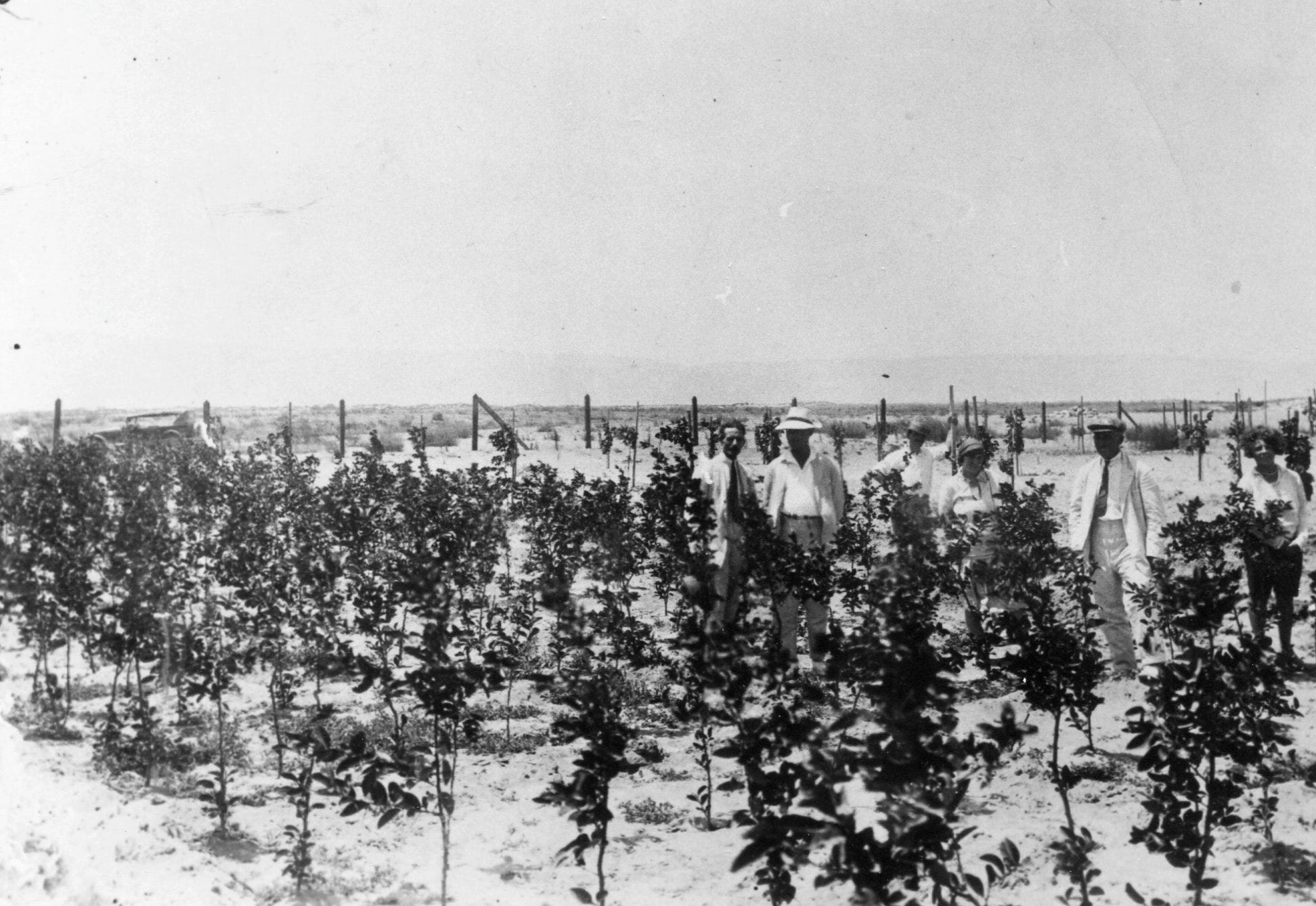
Efraim was a Romanian Zionist determined to show the world’s Jewry that their ancient homeland can again become the land of milk and honey and every possible agricultural product. In 1924, when he was 45, Efraim moved his wife and six children, aged two to eighteen, from Bucharest to Haifa. He bought 30 acres of sand dunes and marshes in the wilderness of Haifa Bay where, without any prior knowledge and experience in agriculture, he developed his Zionism-by-example project.
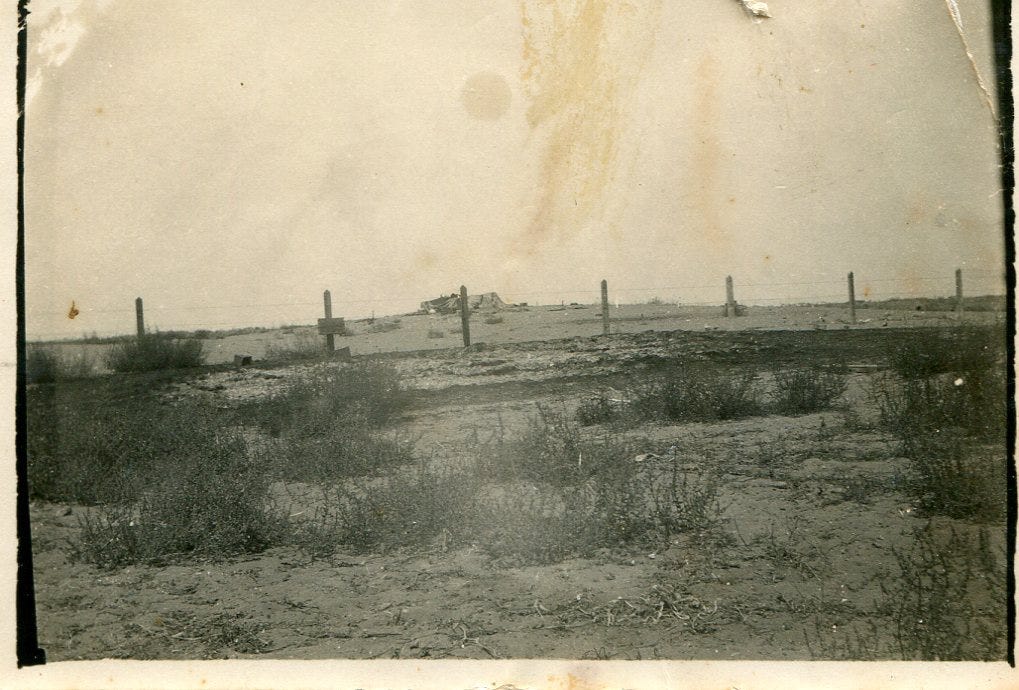
Efraim named his farm Sabinia after his 46-year-old wife Sabina who lived with him there in a wooden hut. He planted eucalyptus trees to drain the swamps and also an orange orchard, a vineyard, a banana grove, a vegetable garden, and lemon, grapefruit, guava, peach, walnut, apple, and pear trees. He raised cows, Leghorn chickens (imported from England), goats, and horses. In 1927, emboldened by his initial success with the Sabinia farm, Efraim leased a 2,500-acre parcel of land about six kilometers from Haifa, and established there a second farm, planting wheat, barley, sunflowers, and flax. Depending on the season, the farms now provided work for up to forty workers, Jews and Arabs.
Efraim did not sell the fruits of his labor. His farms served as a one-man public relations campaign, to prove to the world that with hard work and sheer determination the Land of Israel could be turned into the Land of Plenty, again. With no running water—the water initially had to be hauled to Sabinia in trucks—or electricity, he calculated that the cost of growing and harvesting each orange was about 400 times more than what it would fetch in the market. Efraim’s reward came when strangers would appear at his door asking to see “the orange trees growing in the sand dunes.”
Haj Amin al-Husseini, the Mufti of Jerusalem, saw it differently. He realized early in his career, in 1920, that Jew-hatred and Jew-envy will serve him well in prevailing over inter-family and intra-clan rivals and in dealing with a British colonial administration fearful of Arab violence. In 1928, he started a new phase in his relentless incitement by telling his fellow Arabs that the Jews plan to take over the Al-Aqsa mosque (“If the Jews betrayed Muhammad… why wouldn't they treacherously persecute us today with the purpose of destroying us?”). On August 23, 1929, after the Friday prayers, the Arabs of Jerusalem killed 19 Jews, wounded many and destroyed their property. The next day, 67 Jews were killed and 65 wounded in Hebron, driving away the 600 members of the 400-year-old Jewish community in that city. The riots than spread to other cities and settlements, including Haifa.
For four days the Arabs of Haifa rioted, destroying homes and shops, wounding 107 and murdering seven (one of them a British engineer who was assumed to be Jewish). 3,500 of the 12,000 Jews then living in Haifa became refugees as their homes were ransacked by their Arab neighbors.1
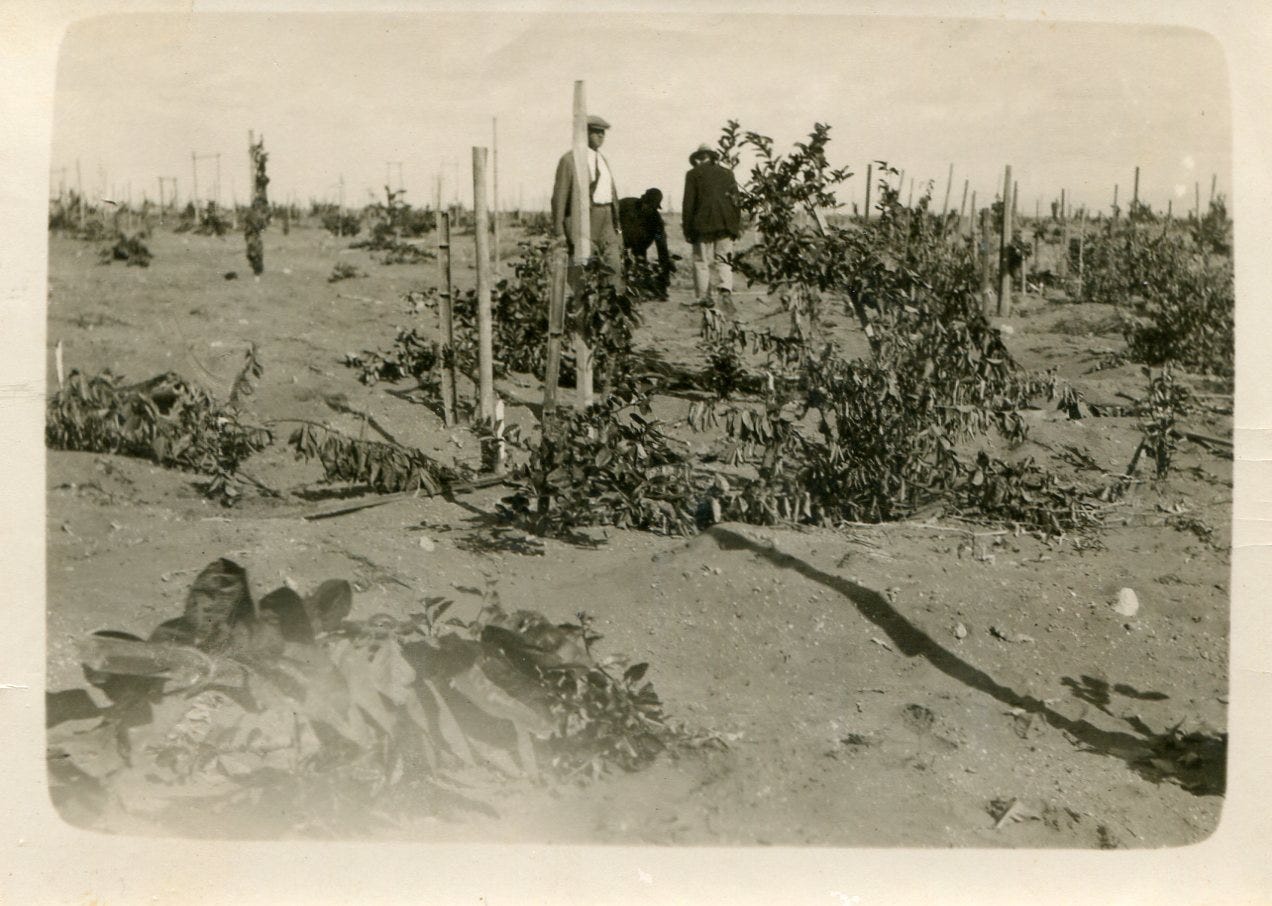
On August 26, 1929, Arabs from the villages situated on the hills overlooking Haifa Bay took all the grain they could find in Sabinia, all the cattle (23 heads), six horses, machinery parts, and the furniture. The next day, they came back and put both farms on fire, destroying the heavy machinery. The property damage was estimated to be about 16,000 Palestine Pounds, the equivalent of about $80,000 at the time, about $1.4 million today.
On November 22, 1929, Sabinia was attacked again. The English-language Palestine Bulletin reported the next day the “widespread damage [that] was done to the orange and banana groves by the uprooting of trees covering an area of more than 10 acres.” Haaretz reported that by the look of the uprooted trees of the 12-acre orange grove, this was the work of at least 10-15 men over 5-6 hours. The Arab policeman guarding the orange trees claimed not to have heard anything.
It was not enough to steal and destroy to placate the deep resentment of what one Jew managed to do in the wilderness. The trees, testifying to his initiative and success, what years later came to be known as “startup nation,” had to be uprooted, the evidence removed.
The 1929 riots ended not only the centuries-long Jewish presence in Hebron but also the Jewish community of Gaza City which has existed there since the days of the Hasmonean king Alexander Jannaeus (103 BCE – 76 BCE). The Arabs of Gaza City attacked the 50 Jews living there in 1929 and the British police evacuated them.
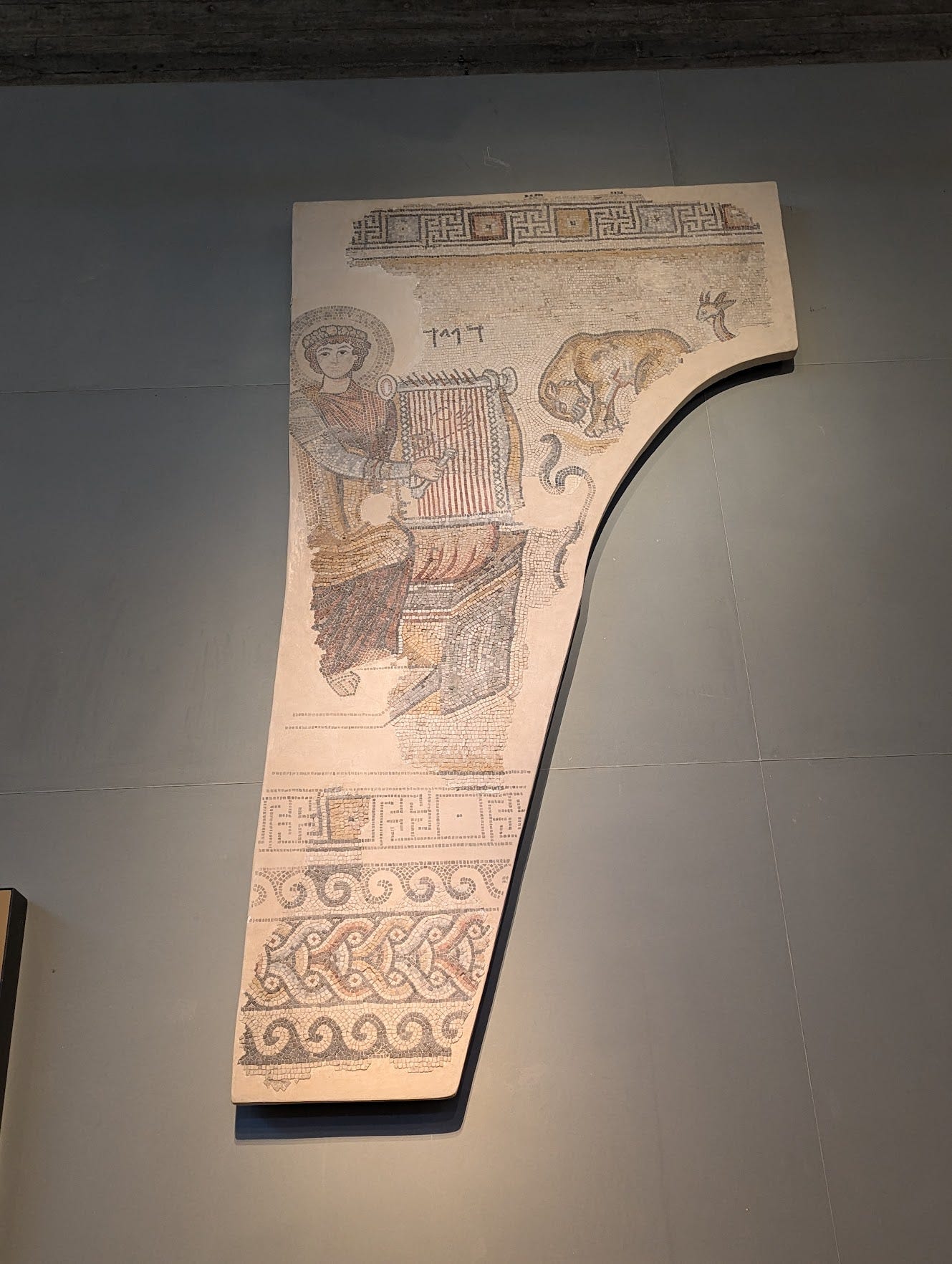
In 1965, Egyptian archeologists discovered in Gaza City a synagogue built around 508 CE. The mosaic floor of the synagogue included a depiction of King David playing a lyre, labelled in Hebrew “David.” The central inscription on the mosaic floor reads, in Greek: "We, Menahem and Yeshua, sons of Jesse, wood merchants, as a mark of respect for the holiest site, donated this mosaic.”
Shortly after the mosaic's discovery, King David's face was gouged out. When Israel captured the Gaza Strip in the 1967 Six-Day War, the mosaic was transferred to the Israel Museum for restoration.
In 1929, French journalist Albert Londres went on an investigative tour of Jewish communities, mostly in Eastern Europe. Londres, who wasn’t Jewish, wanted to explore the “Jewish condition” and what propelled Jewish emigration to Palestine. He reported his findings in a series of articles for Le Petit Parisien, titled “The Drama of the Jewish People: From the Ghettos of Europe to the Promised Land,” compiled a year later in a short book, The Wandering Jew Has Arrived.
Londres described the destitution and squalor of the daily lives of Jews in Europe, outlined the history of pogroms and their horrible statistics, defined pogroms as a form of rabies that infects men and impels the rabid to bite only Jews, and reported the emergence of the “new Jew” in Palestine and the virulent animosity of the local Arabs. Arriving in Tel-Aviv, “bright, spacious, sunny and all white…it emanates a fierce determination to leave the ghetto behind,” Londres observed:
In 1908, no houses [in Tel-Aviv]; in 1920, two hundred and forty… in 1929, almost five thousand!
“Thou shalt be built,” says its motto.
From the moment the first stone was laid, the Arabs responded, “Thou shalt be destroyed!”
Londres described what he called “the day of the grand mufti,” August 23, 1929, in Hebron, starting with how some Arabs urged the Jews to flee. “Not all Arabs are fanatics,” wrote Londres. He then recounted what happened to the Jews who trusted their neighbors, people they knew “from time immemorial”:
They cut off hands, they cut off fingers, they held heads over a stove, they gouged out eyes. A rabbi stood immobile, commending the souls of his Jews to God – they scalped him. They made off with his brains. On Mrs. Sokolov’s lap, one after the other, they sat six students from the yeshiva and, with her still alive, slit their throats. They mutilated the men. They shoved thirteen-year-old girls, mothers and grandmothers into the blood and raped them in unison.
After describing a similar pogrom in Safed, Londres asked “what do the Arabs have to say?” To find out, he met with ten Muslim, Catholic and Greek Orthodox Arabs. Sheikh Monafar told him that the Jews “accidently occupied” in the past “a few corners of Palestine but never all of it” and “they left nothing in the form of civilization… no trace of them remained.” Five hundred sixty years after the Romans drove away the Jews, explained the sheikh, Islam triumphed and “our ancestors retook the land and returned it to its ancient nationality.”
Londres related to the group his recent conversation with Ragheb Bey al-Nashashibi, the Arab mayor of Jerusalem, in which the mayor assured him that once the British troops leave Palestine, the Arabs will kill all the Jews, in two days, all one hundred fifty thousand of them (the size of the Palestine Jewish population in 1929):
I asked the ten if they agreed with Ragheb Bey.
“Definitely!”
“…I think that you are overestimating your strength. The new Jews are not going to let themselves bleed to death. I am even certain that they will pay you back in kind.”
The new Jews did not let themselves bleed to death in 1948, defeating the armies of Egypt, Transjordan, Syria, Lebanon and Iraq (plus Palestinian Arabs), adding Arab humiliation and loss of honor to their hateful existence.
The 1948 Nakba (catastrophe) has served as the clock of legitimacy for army officers subsequently overthrowing the existing regimes in Syria, Egypt, and Iraq, promising not to fail again in the liberation of Palestine. Following the departure of the Ottomans after World War I, and the British and French after World War II, writes Hussein Aboubakr, only Zionism offered a non-Arab antithetical force that Arabs could join together to fight:
…the military conflict with Zionism offered a field for unified effort and struggle that would help dissolve inter-Arab contradictions. On top of this, the legacy of anti-Semitism, which was inflamed during the war thanks to Nazi propaganda, provided a rich and popular vernacular that lent itself easily to revolutionary mobilization. Thus, the struggle against Zionism appealed to the statesman, the intellectual, and the man in the street alike.2
After 1948, the Arabs tried to kick out the Jews by constant terrorist infiltrations and sniper attacks and heavy shelling of border communities and other means, culminating in the greatest humiliation of all when in 1967 the new Jews refused to let Nasser make good on his promise to throw all of them into the sea.
On June 19, 1967, the Israeli government announced its willingness to concede the Sinai and the Golan Heights, captured that month in the Six-Day War, in exchange for peace. What followed were the September 1967 “Three Noes” of the Arab League—No peace with Israel, No negotiations with Israel, No recognition of Israel—and a war of attrition (1967-1970) initiated by the Arabs on three fronts, mostly by Egypt where Israel found itself also fighting the Soviet Union.
On October 6, 1973, Anwar Sadat, Nasser’s successor, moved to restore the Arabs’ honor by launching a surprise attack across the Suez Canal, joined by Syria in the Golan Heights. In the first 5 days of the war, 1,300 Israeli soldiers were killed, thousands wounded and 300 taken hostage, leading Defense Minister Moshe Dayan to believe that Israel was on the brink of total destruction. After a successful counter-attack, the IDF reached the outskirts of Cairo and Damascus. Still, to this day, Sadat is known in Egypt as “the hero of the crossing,” having restored Arab honor to its rightful place.
From this exalted position, Sadat could do what no other Arab leader has done before him, pursue a peace treaty with Israel. In exchange, Sadat wanted the land Egypt lost in 1967 but insisted on getting it back clean of the Jews that settled there after the Six-Day War. Sadat’s Judenrein philosophy resulted in yet another expulsion and uprooting of Jews from their homes.
Prime Minister Menahem Begin explained to the members of the Israeli parliament (the Knesset) on September 25, 1978, the difficult decisions he had to make negotiating a peace treaty with Egypt:
For twelve days and nights we explained incessantly to the American president and all his aides how vital the settlements were in security and moral terms, and how right former governments had been to establish them. President Carter was convinced and tried to persuade President Sadat … and encountered complete rejection. … I consulted our team and we found ourselves unable to agree to remove the settlements, both because we believed that they should remain and because … our task is to implement the policy that the Knesset has decided to undertake. But in that case, the Camp David talks would have failed… As prime minister I knew in my heart of hearts that if Israel was responsible for the breakdown of the talks it would find itself up against America, Europe, U.S. Jewry and world Jewry… I knew that if Camp David collapsed, Israel would stand alone and would eventually have to submit, of that I am convinced…
I proposed a third approach to my colleagues… to bring the subject before the Knesset for its decision. …dismantling of the settlements…is the only practical way of attaining a peace treaty for the first time in thirty years…. In making my calculations I’m thinking of the sons of those settlers who will have to be uprooted. Those sons will not have to fall in battle, because we will have peace… For it is the duty of the prime minister to see to it that there is no more bloodshed, no more orphans and widows and bereaved parents…
The peace treaty was on one side of the scales and the settlements on the other. According to every moral code to which I subscribe, the scales tipped on the side of the peace treaty.
Peace is born, first and foremost, of our blood. For this peace, we have sacrificed 12,000 of our best boys, in five wars, one war after the other, one battlefield after another. We want to put an end to that.
The Knesset voted to uproot the settlements: 84 in favor, 19 against, 17 abstentions.
A few months later, on March 26, 1979, Israel and Egypt signed a peace treaty. The Israeli public started preparing for the total evacuation of the Sinai Peninsula, involving the uprooting of 16 settlements and their inhabitants, including the 625 families, about 2,500 people, then living in Yamit, the city just west of the Gaza Strip Israel started developing in 1975.
In 1980, prompted by the sudden death of her 58-year-old brother-in-law, Naomi Shemer (“The first lady of Israeli song”) wrote and composed “Over All of These,” first sung by the family at the end of their week-long mourning period. The song is a secular prayer, asking God to protect and preserve all that is precious in life, a life that is full of the good and the bad, light and fear, hope and devastation, peace and demolition.3
Over all of these, over all of these
Stand guard for me, my good God
Over the honey and the sting
Over the bitter and the sweet
Don't uproot what’s been planted
Don't forget the hope
May You return me, and may I return
To the good land
Released in 1981, the song and especially “Don't uproot what’s been planted” became the rallying cry of the protest movement objecting to the dismantling of the Sinai settlements. By late April 1982, all the settlements were demolished by the IDF and their inhabitants removed.
After signing the Oslo Accords with the Palestine Liberation Organization, Prime Minister Yitzhak Rabin said when he accepted the 1994 Nobel Peace Prize:
Peace will triumph over all our enemies, because the alternative is grim for us all.
And we will prevail.
We will prevail because we regard the building of peace as a great blessing for us, and for our children after us. We regard it as a blessing for our neighbors on all sides, and for our partners in this enterprise – the United States, Russia, Norway, and all mankind.
We wake up every morning, now, as different people. Suddenly, peace. We see the hope in our children’s eyes. We see the light in our soldiers’ faces, in the streets, in the buses, in the fields.
We must not let them down.
In his 1994 Nobel Lecture, Yasser Arafat extolled the principle of “land for peace.” But when he was offered, in the 2000 Camp David Summit, 97% of the West Bank and all of the Gaza Strip (and a land-link between the two plus a piece of Israeli land as additional compensation) and the dismantling of 63 settlements, he declined. The Al-Aqsa Intifada followed, from September 2000 to September 2004, with 1,030 Israelis (70% civilians) killed and 5,598 (82% civilians) wounded. These casualties were the result of, among other things, 138 suicide bombing events and about 450 rockets fired from the Gaza Strip.
After each major suicide bombing massacre, Prime Minister Ariel Sharon would get phone calls from world leaders, urging him to stop “the cycle of violence.” In October 2004, Sharon sought approval from the Knesset for his plan to “disengage” from the Palestinian Authority, starting with the Gaza Strip:
I am utterly convinced that this disengagement will strengthen Israel in the territory essential for its survival, receive the blessings of those near and far, reduce the terror, break the boycott and siege, and move us forward on the road to peace with the Palestinians and our neighbors.
67 members of the Knesset voted in favor of removing the 8,600 Israelis then living in the Gaza Strip and dismantling their 22 settlements; 45 voted against and 7 abstained.
“The Gaza disengagement was a tremendous gamble for Sharon and for Israel,” writes Michael Oren:
We all knew that the Palestinian terror organizations, Hamas in particular, would declare victory. Yet we hoped that the Palestinian people would seize this historic opportunity to build an independent mini-state. The gamble failed. No sooner had the last Israeli exited the Strip when the Palestinians dismantled the agricultural infrastructure left behind to aid their economy, much of it paid for by American Jewish philanthropists. Over the next six months, terrorist groups fired some 1,000 rockets and mortar shells into Israel.4
Hamas took over the Gaza Strip in 2007. It established there an Islamic dictatorship with the sole aim of eliminating the Jewish state, replacing it with yet another Middle Eastern backward, authoritarian regime.
The endless attacks on civilians, from the Gaza Strip and elsewhere, have convinced many Israelis that the Palestinians only want to kick them out while other Israelis still hoped for a peaceful co-existence. All of the new Jews, however, have always been united in their determination to rise from the destruction and mayhem inflicted by their neighbors, rebuild and renew, and develop an even more successful, modern, democratic and thriving society in their ancient homeland. As “the voice of Israel,” Arik Einstein, wrote and sang in 1998: “Looks like we will stay here forever/Looks like we will never move from here.”5
In 1930, Efraim Catz built a new house in Sabinia—this time it was made of stone and resembled a small fortress with bars on the small windows—and re-created the chicken coop, the stables, and the cowshed. He replanted orange, banana, and other fruit trees. The cellar of his new home housed an incubator, used also by the surrounding kibbutzim that lacked the proper equipment for hatching eggs.
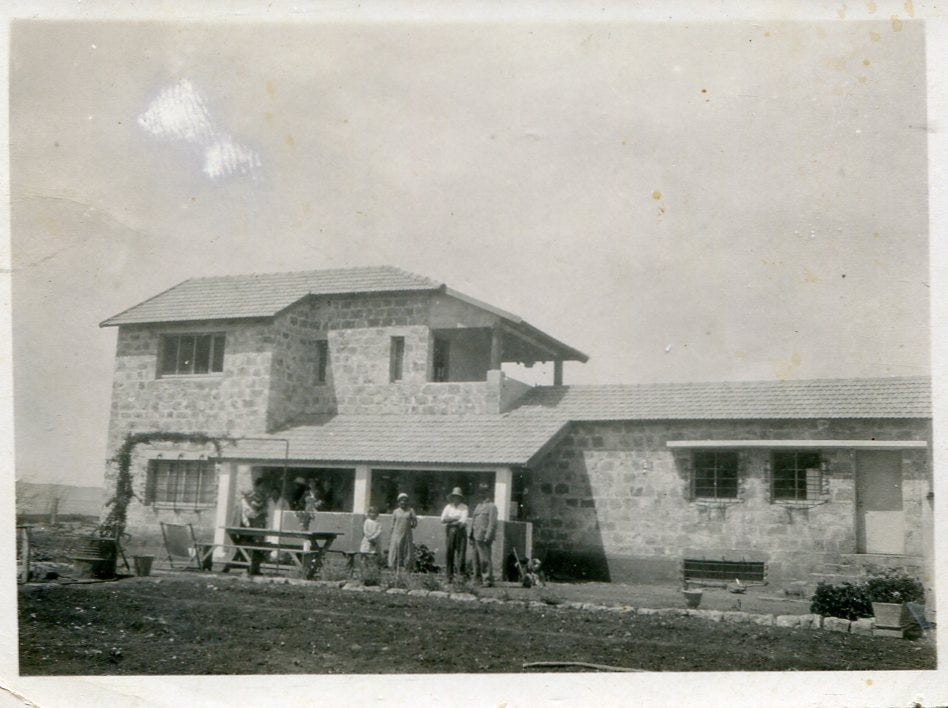
During the following years, the landscape around the farm has changed rapidly and radically. The Sabinia cowshed was demolished to make way for the new highway between Haifa and Acre and a bus service now connected Sabinia directly to Haifa. Efraim welcomed these changes and little by little reduced further the scope of his farming activities. With the great wave of immigration of German Jews fleeing Nazism in the 1930s, the Zionist organizations have decided that the area around Sabinia would be entirely urban. Within a few years, many German Jews built their homes there, establishing in 1934 a new town, Kiryat Bialik.
Immediately after the Hamas attack on October 7, 2023, and the Hezbollah attack on October 8, the Israeli government evacuated about 120,000 residents of communities close to the Gaza border and the Lebanese border. Nine months later, these refugees are still uprooted from their homes, dispersed in temporary lodgings throughout Israel, including the survivors of the Kfar Aza pogrom.
Gali Eilon, Liora’s 15-year-old granddaughter (and Tal Eilon’s daughter), was with her in the safe room when the first handful of IDF soldiers arrived at the kibbutz. The soldiers were not familiar with Kfar Aza and Gali, who was connected via WhatsApp to most kibbutz members, told them she could share with them the location pins of the injured and the locations of the terrorists as reported by the residents. For the next thirty hours or so, Gali used her cellphone to act as a dispatcher for the soldiers arriving at Kfar Aza, coordinating and guiding their movements, and communicating with the besieged residents. After many hours, Liora asked Gali to tell the soldiers to rescue them but Gali responded that there are wounded people that should be rescued before them. Eventually, with terrorists still in the house, the IDF soldiers entered and formed a live protective wall, allowing the Eilon family to escape.
In an interview a couple of weeks later, Gali said: “We will stick together, we will go back, maybe as a smaller community. We will rebuild the kibbutz the way it was before.”
Yigal Greiber, “The 1929 Riots in Haifa,” Haifa, December 2021, pp. 23-30 (in Hebrew). Efraim and Sabina Catz were visiting their children in Haifa when the riots started and, as a result, they were not harmed in the attack on Sabinia.
Hussein Aboubakr, “The Perennial Power of the Nakba,” Mosaic, September 2023. For more on the legacy of antisemitism in Islam, see Liah Greenfeld, “A New Explanation of Antisemitism: Jew Hatred as a Civilisational Phenomenon,” Israel Affairs, July 2024; Andrew Bostom, The Legacy of Islamic Antisemitism: From Sacred Texts to Solemn History, 2008.
Translation by Daniel Gordis, with my minor alterations. Kibbutz Dan evacuees sing Over All of These
Michael Oren, “How Gaza Became Israel's Unsolvable Problem,” Mosaic, June 2021. A 2011 BESA paper documenting the 4,000 rockets and 2,500 mortar shells fired from the Gaza Strip between 2001 and 2008, noted the symbolic firing in 2006 of a rocket towards the city of Ashkelon, 30 miles south of Tel-Aviv, symbolic because of statements by Israeli leadership at the time of the Oslo accords that there will be no rockets from Gaza on Ashkelon and other towns.
WOW, that is quite a piece you wrote.
Personal and national history--both painful--intertwined into just one of so many similar threads making up this amazing country and people.
עם ישראל חי!